
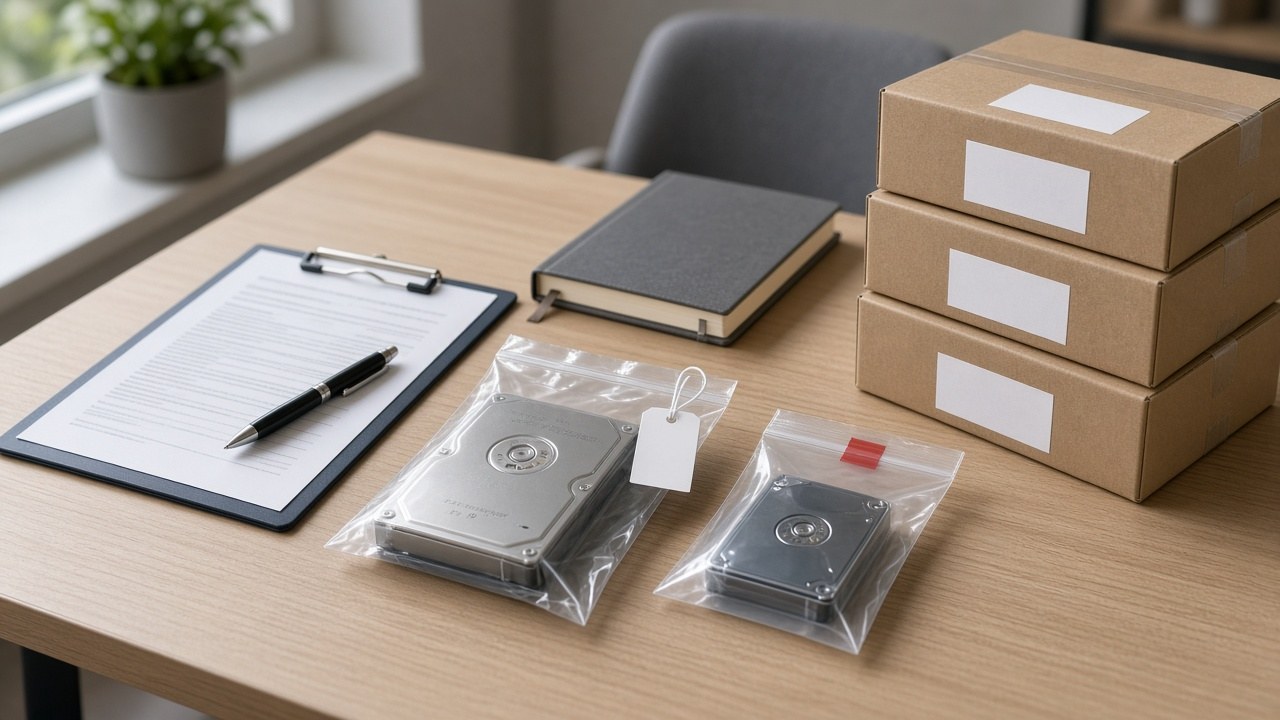
In short: A hard drive chain of custody is the documented trail of which drive was in whose hands, from the moment it is identified for retirement until you receive evidence of erasure or destruction. In Hong Kong, a certificate of destruction is useful, but it is only one piece of that trail. Auditors and overseas compliance teams usually want the inventory, handover records and exception notes to match the certificate. This guide explains the evidence itself — not how to destroy a drive.
This article is general information, not legal advice. Confirm your own obligations with counsel.
What “chain of custody” means for a retired hard drive
In this context, chain of custody is a practical question: can you show, drive by drive, what left your Hong Kong office or data hall, who accepted it, how it was protected in transit or on site, and what was then done to the data?
A complete trail usually ties together:
- Identity: make, model and serial number where they can be read, and whether the device is an HDD, SSD or other media.
- Custody events: who counted it, who packed it, who collected it, and when.
- Protection in transit or storage: seals, locked containers, and any break or reseal.
- The agreed method: software erasure, physical destruction, or another method recorded for that asset.
- Closing evidence: a certificate or erasure report that lists the same serials, plus photographs, video or a witness record if you asked for them.
- Exceptions: missing, unreadable or extra serials, and how they were resolved.
The point is continuity. If the pickup note, the process record and the certificate cannot be reconciled, the chain is weak even if a certificate exists.
Why this evidence matters under Hong Kong’s PDPO
The Personal Data (Privacy) Ordinance (PDPO, Cap. 486) does not prescribe a standard chain-of-custody form. It does require organisations to take all practicable steps to protect personal data against unauthorised or accidental access, processing, erasure, loss or use (DPP4(1)). The Privacy Commissioner for Personal Data (PCPD) has noted that this duty covers the handling of obsolete IT storage equipment sent for disposal or recycling.
If you engage a vendor to process personal data on your behalf, DPP2(3) and DPP4(2) require contractual or other means to prevent the processor keeping the data longer than necessary and to protect it while it is in their hands. The PCPD’s erasure guidance says a service contract for erasure should, at a minimum, cover security during transport and handling, the erasure standard and service level, a mechanism to confirm that erasure was completed, and consequences of non-compliance.
Chain-of-custody records are how many organisations show those “practicable steps” and that confirmation mechanism in practice. They are not a substitute for your own retention and erasure decisions: check what must be kept before any drive is destroyed. The PDPO has no blanket seven-year rule for all personal data; tax and company record-keeping duties are assessed separately. See our guide to PDPO data retention and IT disposal.
Official sources: PCPD Guidance on Personal Data Erasure and Anonymisation; PCPD guidance on outsourcing to data processors.
The evidence pack auditors typically ask for
Requests vary by group policy, but overseas audit and security teams often look for a pack that can be read without a site visit:
- Asset inventory — a list prepared before or at collection, with serial numbers where they can be read. Note any drive whose label is missing or unreadable rather than inventing a number.
- Handover record — a collection note signed or acknowledged by your staff and the collector, with date, location, seal or carton counts, and any discrepancy at the door.
- Transport and storage record — how media moved from the collection point to the place of erasure or destruction, including seal numbers if used, and any transfer between custodians.
- Process record — the method actually used for each asset or batch, the date and location, and the operator or job reference. This is a record of what was done, not a public description of equipment settings.
- Closing documents — a certificate of destruction and/or software erasure reports that can be matched back to the same serials. For what a certificate typically includes, see Certificate of Destruction in Hong Kong.
- Optional visual or witness evidence — agreed photographs, video, or on-site witnessing. These only help if they can be tied to the same job and serials. If you need a witnessed process at your premises, see the on-site hard drive destruction witness service.
- Exception log — items added, withdrawn, damaged, or not processed as planned, and the approval for that change.
If you only receive a one-line certificate with a total quantity and no serials, you may have a receipt, not a reconcilable chain.
Where chains of custody usually break
Most gaps appear before any equipment is used:
- Drives are pulled from servers after the inventory was printed, so the list no longer matches the cartons.
- Laptops are collected as “units” and the internal drives are never serialised.
- Seals are not recorded, or a carton is opened and resealed without a note.
- Sub-contracted transport or processing is not disclosed, so you cannot see who had custody.
- Photographs show a pile of media but no job reference or serial.
- The certificate arrives later with a different count and no explanation.
- SSDs, USB devices or tapes in the same job are omitted because the brief said “hard drives” only.
Build the inventory around every data-bearing item in the job, not only 3.5-inch disks. If some media will be reused after verified erasure and others will be physically destroyed, record that split on the list.
On-site and off-site jobs need different evidence, not different standards
The standard is the same: you should be able to follow each drive. The paperwork changes with the location.
For an off-site job, the weaker link is often transit. Ask how media will be packed, whether containers are sealed, who is allowed to break a seal, and what happens if a count changes on arrival at the facility. See offsite data destruction in Hong Kong for the service context; this page stays on the evidence trail.
For an on-site job, transit risk is lower, but you still need an inventory, a record of what was processed in front of your staff, and closing documents that match. Witnessing is part of the evidence, not a replacement for serial lists.
Hong Kong Recycling Trading Company Limited (HKRT) can support either model from its Fanling workshop or at your site, depending on the agreed plan. We do not treat one model as automatically “more compliant” than the other; the records have to fit the job.
How to brief a vendor before collection
Send a clear brief, even if your Hong Kong list is still being finalised:
- Location, access window, and who may sign the handover.
- Approximate quantities and media types (HDD, SSD, laptops with drives installed, tapes, USB).
- Whether serial capture should happen before equipment is moved.
- The evidence you need: certificate, erasure report, photographs, video, witness attendance.
- Whether any sub-contracting is permitted.
- Any media that must be retained or withheld from destruction until a legal hold is cleared.
HKRT can review a draft asset list or a rough count and location, then propose a documentation plan and a quote. This article does not quote a fixed turnaround, a destruction size, or a standard certificate format; those depend on the job and should be agreed in writing.
What HKRT can provide, and what this article does not promise
HKRT is Hong Kong Recycling Trading Company Limited. We hold ISO 9001, ISO 14001, ISO 27001 and ISO 45001 management system certifications. These are quality, environmental, information security and occupational health and safety certifications. They are not a waste-treatment operator licence, and they do not make a chain-of-custody file automatically legally conclusive.
On request, and as agreed for the project, we can:
- Help capture or verify serial numbers at collection.
- Provide handover documentation and, where agreed, sealed containers.
- Record the method used and issue a certificate of destruction and/or erasure reports matched to the inventory.
- Arrange staff witnessing, photographs or video.
- Flag discrepancies instead of closing a job with an unexplained count difference.
We use licensed Blancco software for data erasure where that method is agreed. That does not make HKRT an official Blancco partner or a “Blancco certified” company.
This article does not guarantee same-day collection, a fixed number of days to issue documents, GPS tracking on every journey, or a single destruction size or method. It does not claim that a certificate is legally binding in every audit or court setting, and it does not replace your PDPO, tax, accounting or sector-specific retention decisions. It also does not describe or illustrate the operating method of destruction equipment.
Need chain-of-custody records for a Hong Kong drive retirement?
Send us your asset list or a rough count and location, plus the evidence your auditors expect, and we will reply with a documentation plan and quote.
Hong Kong Recycling Trading Company Limited (HKRT)
Frequently asked questions
Is a certificate of destruction the same as a chain of custody?
No. A certificate is usually the closing document. A chain of custody is the trail that shows how each drive got from your inventory to that certificate, including handovers and exceptions. Ask for both, and check that the serial numbers match.
Does the PDPO require a specific chain-of-custody form?
No specific statutory form is prescribed. DPP4 requires all practicable steps to protect personal data, including when storage media is sent for disposal. If a vendor processes personal data for you, you also need contractual or other security and retention controls. Records are how many organisations demonstrate those steps. See the PCPD erasure guidance.
What if a serial number cannot be read?
Record that fact, with the location, condition and any alternative identifier such as an asset tag, slot or photograph. Inventing a serial number creates a false trail. The exception should follow the drive through to the closing documents.
Do SSDs and tapes need the same chain of custody as hard disk drives?
If they can hold data, they should be on the same inventory and evidence trail, even if the agreed method differs. A job labelled “hard drives only” is a common way for other media to leave without a record.
Should we choose on-site destruction to keep the chain of custody intact?
On-site processing can reduce transit handover points, which some organisations prefer. It is not automatically more complete than a well-documented off-site job. Choose the model that fits access, volume and the evidence you need, and write the records to match.