
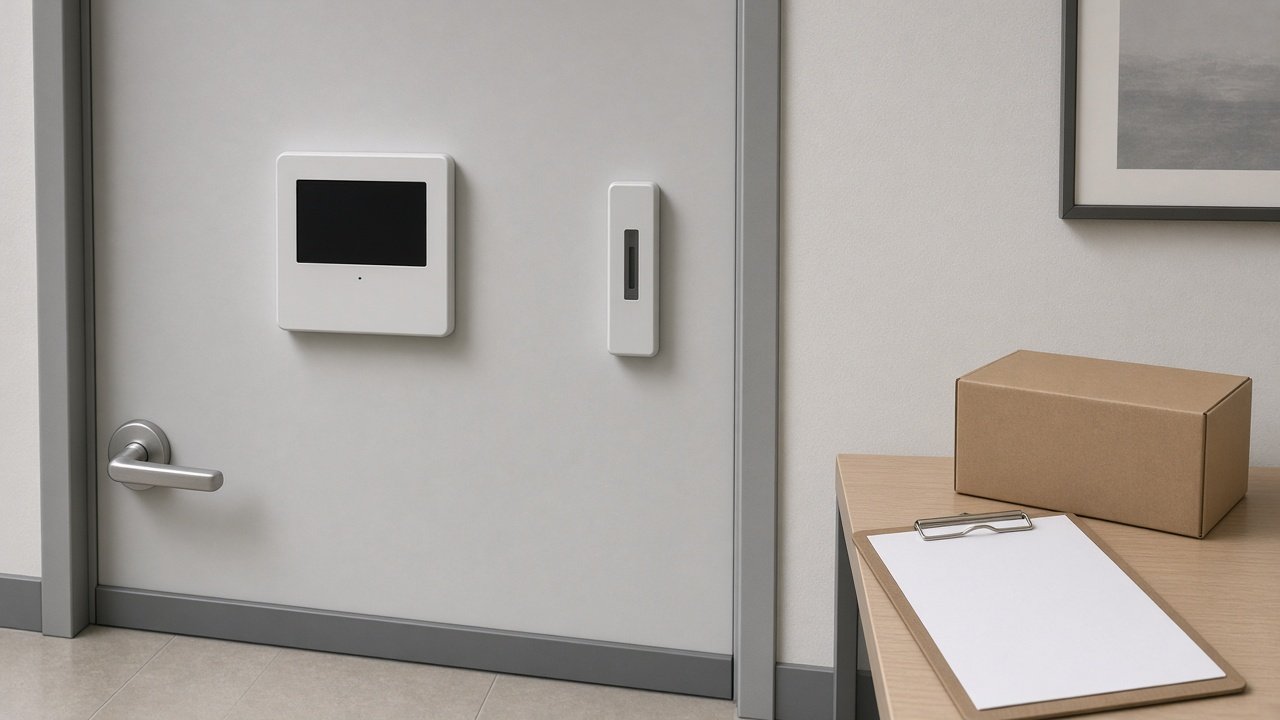
In short: When a Hong Kong office has to retire office access control hardware — the door controllers and access control panels that decide whether a door unlocks, and the card, fob or PIN readers or keypads that belong to that panel or system, including controllers sitting in a riser or a comms closet — the job is not finished by unscrewing a reader from the corridor wall. The kit is not a room-booking or scheduling panel, it is not a visitor kiosk, it is not a time-attendance terminal, it is not a CCTV or NVR unit, it is not an IP phone, it is not a wireless presentation system, and it is not a Wi-Fi access point. Many controllers still hold cardholder records, administrator passwords or PINs, door schedules, audit or event logs, and network or controller credentials. A USB port, an SD card or a configuration backup can still travel with the unit. On some biometric models only, templates may still be present; many simple standalone readers hold little more than a facility code or a local cache, and this page does not assert that every panel holds biometrics or a full HR database. Leased, landlord-provided, serviced-office, facilities-managed or company-owned units often have different return rules. Returning the hardware, or sending owned units for recycling, does not by itself end the organisation’s duty to protect personal data still stored on the unit, on leftover media, or in a connected directory. Confirm the return rules in writing if the hardware is not yours, clear what you are allowed to clear, and keep a record of what was actually done.
This article is general information, not legal advice, and it is not a summary of any particular lease, landlord, serviced-office, facilities-management or managed-service contract. Not every office access control panel or reader stores the same data, and many simple standalone readers hold little more than a facility code or a local cache. Platforms and models differ. Check the unit in front of you, and ask the vendor, landlord, serviced-office operator, facilities manager or managed-service provider to confirm the return rules in writing, before you reset, clear a database, recycle, or withhold a unit that does not belong to you.
Why retiring an access control panel is not the same as retiring a booking panel, an attendance terminal, a camera recorder or a network box
An office door access control system is built to decide whether a particular door, turnstile or cabinet lock should release for a presented card, fob, PIN or, on some models, a biometric sample. The controller or panel is usually the unit that holds the decision rules. The reader or keypad on the wall is the part people see. In a Hong Kong office the controller is often out of sight: in a riser, a comms closet, a ceiling void, or a small enclosure above the door. When a floor is packing for a closure, a move, or a hardware refresh, that split makes it easy to treat the wall reader as “just another panel,” and to leave the actual controller behind — or to drop several different wall devices into the same carton.
This guide is about those office door access control panels, door controllers, and the readers or keypads that belong to that panel or system. It includes the accessories that usually travel with that kit — power supplies that belong to the controller, enclosures, mounting plates, door-interface boards, and leftover configuration media — because those parts are often retired in the same job and are easy to leave in a closet. It is written for overseas headquarters and regional IT, security, facilities or compliance teams retiring this hardware in Hong Kong, including a floor that is moving, a branch that is closing, or a serviced-office fit-out being handed back.
It is not a guide to retiring a room-booking or scheduling panel. A booking panel on a corridor wall or beside a meeting-room door answers a calendar question: whether the room is free, who booked it, and how to start or extend a meeting. It may sit a few centimetres from a door reader, and both devices can look like a small wall panel, but they store different records and they usually belong to different systems. Unplugging or resetting the door controller does not clear the booking panel, and the two devices should be inventoried on separate lines.
It is not a guide to visitor kiosks or lobby check-in terminals, and it is not a guide to time-attendance terminals or punch-clock style devices. A visitor kiosk is built to register a guest and, in some offices, to print a badge. A time-attendance terminal is built to record when a person started or ended work. Some workplaces use the same card or fob for the door and for attendance, and some vendors sell hardware that can be configured for more than one of those jobs. That overlap is why the inventory line matters. If the device in front of you is primarily a door controller or a reader for a door system, this page applies. If it is primarily an attendance terminal or a visitor kiosk, treat it as a different device, even if a card from the same wallet works on both.
It is not a guide to CCTV cameras, video recorders or NVR units. A door event log is not footage, and retiring a controller does not retire the recorder in the same closet. It is not a guide to desk IP phones or conference speakerphones, which are already addressed in the office IP phone retirement note. It is not a guide to meeting-room wireless presentation systems. And it is not a guide to retiring a Wi-Fi access point, or a WLAN controller. An access control panel may sit on the same LAN, and a reader may use a network connection, but resetting the door system does not clear the wireless network, and this page does not compete with the access-point retirement note.
Electric locks, magnetic locks and door hardware are often part of the same installation, but they are not automatically yours to remove. In a multi-tenant building or a serviced office, the lock on the staircase, the riser, or the main entrance may belong to the landlord or the facilities manager even when the office’s own internal readers are company-owned. Confirm in writing which items are being taken down, and do not treat a building lock as scrap just because a reader came off the wall. Those devices can travel in the same collection only when ownership and return rules allow it. Keep them on their own inventory lines. If a leftover USB stick, SD card or configuration backup found with a controller is later treated as a drive or a media item in its own right, handle that item as its own inventory line; for the evidence trail on drives, see our note on hard drive chain of custody in Hong Kong.
What may still be stored, attached, or recorded — and what often is not
What a unit can hold depends on the model and on how it was used. A simple standalone reader at a store-room door may hold little more than a facility code, a small local card list, or a short cache of recent events. A networked controller in a comms closet, or a panel that talks to a central server or a vendor-hosted directory, can hold much more. It is worth separating the common cases, because the risk is not the same for every box, and it is not the same as the risk on a laptop, a file server or an HR system. This page does not assert that every panel holds the same data.
- Controller databases or cardholder records. Many door controllers keep a local database of card or fob numbers, names or employee identifiers, validity dates, group or door permissions, and whether a credential has been cancelled. Some systems store only a card number and a permission; others store a name, a department, a photograph reference, or a visitor record. That local copy can still be present after the door has been taken off the system, and it may not be a complete copy of your HR file. Do not assume that every panel holds a full staff directory, and do not assume that a blank screen means the memory is empty.
- PINs, administrator passwords and service accounts. A controller or a keypad often has a local installer or administrator password, a door PIN, a duress code, or a password for a web or software management page. That credential may still be the default, a code reused across every door on the floor, or a password written on a paper label inside the enclosure or in a facilities binder. Those accounts can still be present after the office has been emptied. A PIN pad on the wall can also hold locally enrolled codes that were never written down elsewhere.
- Door schedules, unlock rules and holiday calendars. Many systems keep the rules that say when a door is locked, when it is held open, which group can pass at which time, and how public holidays or special hours were configured. Those rules are not usually a staff database, but they can still describe how the office was secured and who was expected to have access at particular times. A leftover schedule is not automatically a tax business record.
- Audit or event logs. Some controllers and many managed systems keep a local log of door events: a card or fob identifier, a door name, a timestamp, and whether access was granted or denied. Logs may also have been sent to a server, a syslog collector, a building-management platform, or a security operations tool. A leftover log can contain personal data, especially if it can be tied to a named person. It is not automatically a tax business record, and it is not automatically disposable; that depends on what the log actually contains and on your own retention rules.
- Network and controller credentials. A networked panel or controller can hold a static IP address, a hostname, DNS or proxy settings, a VLAN or switch-port identity, and the credentials used to join the office LAN or to talk to a central server. Some units also hold certificates, API tokens, or the password for the management software. Those items can remain after the reader has been taken off the wall, and they may still match a network, a server or a replacement controller that remains in use elsewhere in the building.
- Leftover USB, SD or configuration backups. Many controllers and some readers have a USB port, an SD slot, or a local method for saving a configuration or a firmware file. A stick, a card or a backup file left in the enclosure can travel with the unit and can hold a copy of the cardholder database, a schedule, a log export, or files that have nothing to do with the door system. Inspect ports, slots and the inside of the enclosure before the unit is packed. Handle leftover media under your removable-media policy; do not leave the stick or the card in the controller.
- Biometric templates, on some models only. Some readers or panels can store fingerprint, face or other biometric templates, either on the device or as a reference that is checked against a central system. Many card-only or PIN-only readers store none of that. This page does not assert that every access control panel holds biometrics, or that a biometric reader always keeps a full template after a person has left. If the model in front of you has a biometric function, treat any remaining template as personal data and follow the vendor’s supported clear or delete procedure — if you are allowed to use it — rather than assuming a power-off has removed it.
Just as important is what this hardware often does not hold. An access control panel is not typically a complete HR system, a payroll database, or a full copy of every door event your organisation has ever recorded. Many events, cardholder records and biometric templates, where they exist at all, live on a central server, an administration workstation, a vendor-hosted or cloud directory, or a landlord or facilities-management platform. Clearing or packing the wall unit does not automatically clear those copies. A simple standalone reader may hold little more than a facility code or a short local cache, and inventing a rich database that the model cannot store does not help the record.
Paper is easy to miss in this job. A cardholder list printed for a weekend opening, a handover sheet in the riser, a default password on a label inside the enclosure, or a visitor card still in a drawer can leave with the hardware or be left behind when the hardware goes. Treat printed lists and leftover cards or fobs as part of the same retirement, under your own records and media rules, rather than as an afterthought once the carton has been sealed.
A factory reset or a database clear is often important — and is not automatically sufficient
For a networked controller or a managed panel, a supported factory reset, a default-configuration reload, or the vendor’s documented procedure for clearing a cardholder database, administrator passwords or PINs, door schedules, audit logs, network credentials and, where the model actually has them, biometric templates, can be an important step before the unit leaves your control — if the owner of the hardware allows it. Clearing a reader that holds a local cache, a PIN list or a template can be an equally important, and sometimes separate, step. A still-valid administrator password, a leftover card list, or a reader that is still enrolled to a live controller can otherwise travel with the kit to a lessor, a recycling site, or another floor.
A reset is not automatically required for every simple standalone reader, and it is not automatically the same thing as deleting a central database. Some models offer a reset on the controller but leave a cache on the reader; some clear a local keypad without touching the controller in the closet; some remove a live connection without wiping stored logs. Inventing a step the hardware cannot perform does not help the record. A reset is also not automatically allowed on a unit you do not own. Some return conditions expect the system to come back in a working, still-configured state, sometimes still joined to the provider’s server or still holding the building’s standard door schedules.
A reset or a database clear is never automatically sufficient. It does not remove a USB stick or an SD card left in the enclosure, a paper label inside the cabinet or in a facilities binder, a configuration copy stored on an administration workstation, an integrator’s laptop, a backup file, or a vendor-hosted or cloud directory, or a credential that still exists on a remaining controller, a replacement panel, or another floor that reused the same administrator password. If a credential remains valid after the old box is packed, your own IT or security team still has to decide whether to revoke or rotate it. If the model has no supported reset, or you are not allowed to use one, record that fact rather than inventing a step the hardware cannot perform.
Readers, keypads and controllers need the same caution, without assuming that one action clears every piece. A floor can have a main controller in the closet, several door readers, a spare reader in a drawer, and a keypad that was added later. A leftover staff card or a contractor fob can sit in a reception desk. Treat each physical controller, panel, reader and keypad as its own inventory line, and confirm what the model in front of you actually does, rather than assuming that resetting the controller, or unscrewing the wall reader, has cleared every related device or every copy of the directory.
Leased, landlord-provided, serviced-office, facilities-managed and company-owned units
Ownership decides what you are allowed to do. An office access control panel or door reader may belong to the company, to a landlord or serviced-office operator as part of a building or fit-out system, to a facilities-management company, to a security integrator or a managed-service vendor, or to a hardware lessor. The same floor can hold a mix of these: company-owned readers on internal store-room doors, and a building-standard controller on the main entrance or the riser. Confirm that in writing before you reset, clear a database, recycle, or withhold a unit.
If the hardware is leased, landlord-provided, installed as part of a serviced office, or operated under a facilities-management or managed-service agreement, the return rules in that contract come first. Some providers expect a complete, working system — controllers, readers, keypads, power supplies, and sometimes the original packaging or mounting kits — to go back to them. Some expect you not to reset the unit, because their team will reuse or inspect it. Some will reset it themselves and will tell you, in writing, what they will and will not clear. Recycling or destroying a unit that does not belong to you, or stripping a reader off a landlord door against the contract, can create missing-parts, access-control or handover issues. Ask for those rules in writing, including who is responsible for clearing cardholder data, logs, credentials and any templates, and keep that reply with your retirement record.
Company-owned units are a separate decision. If your organisation owns the controllers and the readers, you can usually decide whether to reset them, whether to retain a copy of any records you still need, and whether to recycle the hardware in Hong Kong or to move it to another site. Ownership of the box is not the same as a licence to ignore personal data still stored on it, and it is not the same as permission to remove a lock or a reader that is actually part of the landlord’s system. If you are unsure, treat the unit as not yours until the owner is confirmed in writing. A handover email, a fit-out schedule, or an asset register is more useful than an assumption made on packing day.
Serviced offices and multi-tenant floors deserve a little extra care. The reader on your suite door may be on the operator’s system. The controller in the shared riser may serve several tenants. The attendance or visitor device at reception may look similar and may not be yours. If your team is leaving a serviced office, or handing a floor back at the end of a lease, confirm which access-control items are included in the make-good or the landlord inventory, and do not pack a building device because it was easy to unscrew. For a wider view of equipment questions during a Hong Kong office move, see our note on office relocation and computer disposal.
Personal data, retention and tax records are not the same issue
Hong Kong’s Personal Data (Privacy) Ordinance (PDPO) and Inland Revenue record-keeping rules answer different questions. One is about whether personal data should still be kept, and how it should be protected or erased when the original purpose has ended. The other is about business records that a person carrying on a trade, profession or business in Hong Kong may have to retain for tax purposes. They are not interchangeable, and retiring an office access control panel does not collapse them into a single “keep everything for seven years” or “delete everything now” rule. For a longer discussion of that distinction in an IT-disposal setting, see our guide to PDPO data retention and IT disposal in Hong Kong.
On 28 November 2026 this publishing environment retrieved the Inland Revenue Department’s English record-keeping page at https://www.ird.gov.hk/eng/tax/bus_rke.htm (HTTP 200, 45,501 bytes, page title “IRD : Record Keeping”). That page states that section 51C of the Inland Revenue Ordinance requires every person carrying on a trade, profession or business in Hong Kong to keep sufficient records in the English or Chinese language of his income and expenditure to enable the assessable profits to be readily ascertained, and that such records shall be retained for a period of not less than 7 years. The records prescribed on that page include books of accounts, vouchers, bank statements, invoices, receipts, records of assets and liabilities, and day-to-day records of money received and expended, among other items listed there.
That seven-year period applies to those business records. It does not automatically apply to leftover access logs, a cardholder list, a PIN, an administrator password, a door schedule, a network credential, a biometric template, or a configuration backup that is not a tax record. Do not store every leftover log or card list found on a door controller for seven years “because of tax,” and do not delete a business record you are required to keep only because a copy once sat on a USB stick left in a controller enclosure. A legal hold, an investigation or a contract may also require you to retain particular records. This article cannot tell you which of your files falls into which category; your own legal, tax and records teams have to make that call.
The official PCPD English “ordinance at a glance” page and the erasure guidance PDF are linked here for reference: https://www.pcpd.org.hk/english/data_privacy_law/ordinance_at_a_Glance/ordinance.html and https://www.pcpd.org.hk/english/publications/files/erasure_e.pdf. Live fetches on 28 November 2026 returned HTTP 200, but the bodies were short JavaScript bot-protection pages, not the document text. This article therefore links those official URLs and does not quote them, because the files could not be retrieved from this publishing environment on that date.
A practical order of work
The useful sequence is usually the same, even when the models differ. Adapt it to the contract in front of you, and to what the hardware can actually do. If a step is not allowed, or the model has no supported function for it, record that and move on. This is a practical checklist, not a mandatory legal process.
- Confirm ownership and return rules in writing. Identify whether each controller, panel, reader and keypad is company-owned, leased, landlord-provided, part of a serviced-office fit-out, or operated by a facilities-management or managed-service provider. Ask, in writing, whether you may reset or clear the unit, whether a complete working system must be returned, and who is responsible for cardholder data, logs, credentials and any templates. Do not recycle hardware you do not own.
- Inventory the system as it actually is, not only the parts on the wall. Walk the floor and the riser or comms closet. Count controllers and panels, door readers, keypads, spare units, power supplies that belong to the system, enclosures, and any leftover USB, SD or configuration media. Note door or room names if they are useful for your record. Keep electric locks and landlord door hardware on a separate line until ownership is clear. Keep room-booking panels, visitor kiosks, attendance terminals, CCTV or NVR units, IP phones, wireless presentation kits and Wi-Fi access points on their own lines, even if they come off the same wall or leave in the same collection.
- Find the copies that do not live inside the box. Ask your security, IT or facilities team whether cardholder records, logs, schedules or templates also exist on a central server, an administration workstation, a backup file, a vendor-hosted or cloud directory, or a landlord or building-management platform. Packing the hardware does not clear those copies. Decide, under your own policy, what must be retained, what should be revoked, and what the provider will handle.
- Export or retain only what your own records policy actually requires, before any allowed clear. If you need a copy of a configuration, an asset list, or a particular record for your own files, take that copy first and store it in the official place your organisation already uses for records. Do not create a shadow archive of cardholder lists or door logs “just in case,” and do not treat leftover access logs, cardholder lists, PINs or biometric templates as Inland Revenue seven-year tax records unless your own tax or records team has decided that a particular file really is that kind of business record.
- Revoke or rotate credentials that will remain valid after the hardware leaves. An administrator password reused on other doors, a service account, a certificate, a management-software login, or a contractor card that still works on a remaining entrance is not solved by packing the old controller. Your own IT or security team should decide what to revoke or rotate, including cards and fobs that will not be returned.
- Use the supported reset, default or database-clear procedure if you own the unit or have written permission to do so. Follow the vendor’s documented method for the model in front of you. Clear the controller and, where they store their own data, the readers and keypads. If a biometric function is present, use the supported template-clear step rather than assuming a factory default has done it. If you are not allowed to reset the unit, or the model has no supported procedure, record that limitation instead of inventing a step.
- Inspect ports, slots and the enclosure for leftover media and paper. Remove USB sticks, SD cards, configuration backups and any printed card lists or password labels that should not travel with the hardware. Handle leftover media under your removable-media policy. Do not leave a backup stick in a controller that is going back to a lessor or out for recycling.
- Pack what the return rule requires, and keep a written record of what was actually done. Return complete systems when the contract says so. Recycle only hardware you own, or hardware the owner has released in writing. Record models, counts, ownership, whether a reset or clear was completed, attempted, not allowed or not applicable, and what happened to leftover media. Keep any vendor or collection receipt with that note.
If this work is part of a wider Hong Kong floor clearance, it helps to give the access-control system its own time window. Readers come off walls quickly; controllers in a locked riser do not. A leftover live controller can still open or refuse a door after the readers have been packed, and a leftover reader can still hold a cache after the controller has gone. Overseas or regional teams coordinating a branch close or a handover may also find our note for overseas companies handling IT assets in Hong Kong useful for the wider disposal context; that page is not a substitute for the ownership and clearing questions on this one.
What to record before the hardware leaves
A receipt that only says “IT equipment collected” is a weak record for an access control system. The useful note is the one that would still make sense a year later, when someone asks which doors were taken down, whether a database was cleared, and whether the hardware was yours to recycle. You do not need a long report for every standalone reader, but you do need enough detail to show what was in front of you and what was actually done.
- The make and model if they are known and visible, and asset or serial numbers if they are on the unit. If the model cannot be read, say so rather than guessing a brand or a type.
- A count of controllers or panels, door readers, keypads, spare units, and the accessories that belong to the system, such as power supplies, enclosures or leftover configuration media. Note the site and, where it helps, the floor, riser, closet or door name.
- Whether each group of units is company-owned, leased, landlord- or facility-provided, part of a serviced-office fit-out, or supplied as a managed-service device — or a note that ownership is still unconfirmed.
- Whether leftover USB, SD or configuration media, printed card lists, or password labels were found, and what was done with those items.
- Whether a supported factory reset, default reload or database clear was completed, attempted, not allowed by the owner, or not applicable to the model. If readers or keypads needed a separate step, say whether that step was done. If a biometric function could not be confirmed, or a template clear could not be verified, record that limitation.
- Whether your team reviewed administrator passwords, PINs, network or controller credentials, or cards and fobs that may still be valid outside the unit, and what was decided about revocation or rotation.
- Any written return instruction from the lessor, landlord, serviced-office operator, facilities manager or vendor, and any collection or handover receipt. Keep those documents with the inventory note. A receipt for the hardware alone may not show what happened to cardholder records, logs, credentials, leftover media or any templates.
Photographs can help if they show the unit, the asset label and the packed carton, and if they do not capture readable cardholder names, card numbers, PINs, biometric images or other personal data. A blank inventory checklist in the shot is enough; a screen full of names is not. If you cannot photograph a screen safely, describe the state of the unit in writing instead.
How HKRT can help — and what we will not claim
Hong Kong Recycling Trading Company Limited (HKRT) can help a Hong Kong office retire office access control panels, door controllers and the readers or keypads that belong to that system when the company owns the hardware, and can discuss a practical handling plan once we have a model list, a rough count and the location. If the units are leased, landlord-provided, supplied by a serviced office, operated by a facilities manager, or issued as a managed-service device, we can help you frame the questions to ask the provider. We cannot override that contract, and we cannot log into a third-party lessor, landlord, vendor, building-management or facilities-management system on your behalf unless that access is separately and expressly arranged — this article does not offer that service.
We will not, in this article or in a casual quote, claim any of the following:
- A price, a same-day promise, or a guaranteed turnaround for every office access control job.
- That every unit will be processed to a stated shred size, or that a hard-drive process will be applied to every access control panel, door controller, reader or keypad.
- That a factory reset, a database clear, or any single method, is sufficient for every model, or that every access control panel stores personal data, a full HR database, or biometric templates.
- That we will issue, for every unit, the same style of report that may be issued when licensed erasure software is used on a computer drive.
- That HKRT is an official partner, official certified centre, or official certification body for any erasure-software vendor. Where licensed Blancco software is used, it is because HKRT holds a software licence; that is not the same as an official partner or certified-centre appointment, and an access control panel, door controller, reader or keypad is often not a suitable candidate for that method.
- That ISO 9001, ISO 14001, ISO 27001 or ISO 45001 is a waste-processor or e-waste disposal licence. They are management-system certifications. HKRT also holds a chemical waste producer registration; that is not a waste-treatment or collection licence.
- That office access control panels, door controllers, readers or keypads are, in every case, regulated electrical equipment under Hong Kong WEEE rules. This article does not classify the hardware that way.
- Legal advice on your lease, a landlord, serviced-office, facilities-management or managed-service contract, the PDPO, a tax record-keeping decision, or a legal hold.
If you already have a model list or a rough count, the Hong Kong location, the collection date if you have one, and a note on whether the units are owned, leased, landlord- or facility-provided, or supplied as a managed-service device — or a note that you still need help framing those questions — send that and we will reply with a plan and a quote for work in Hong Kong.
Retiring office access control panels in a Hong Kong office?
Send us the model list or a rough count and location, whether the units are owned, leased, landlord- or facility-provided, or supplied as a managed-service device, and the collection date if you have it, and we will reply with a plan and quote for work in Hong Kong.
Hong Kong Recycling Trading Company Limited (HKRT)
Contact us 24/7 on +852 3619 4638.
Frequently asked questions
Do office access control panels usually store personal data?
It depends on the model and on how the unit was used. Many door controllers can hold cardholder records, administrator passwords or PINs, door schedules, audit or event logs, and network or controller credentials. Leftover USB, SD or configuration media can also travel with a controller. On some biometric models only, templates may still be present; many simple standalone readers hold little more than a facility code or a local cache, and not every panel holds biometrics or a full HR database. Staff files usually live on HR or security servers, not only on the wall unit. Check the model in front of you rather than assuming it is empty, or that it holds a complete staff directory, or that every access control panel stores personal data.
Is a factory reset or database clear needed before we return or recycle office access control hardware in Hong Kong?
For a networked controller or a managed panel that you own, or that you have written permission to clear, a supported factory reset, default reload or database clear is often an important step. It is not automatically required for every simple standalone reader, it is not automatically allowed on hardware you do not own, and it is not automatically sufficient. A reset does not remove leftover media, paper lists, copies in a cloud or vendor-hosted directory, or a password that still works on another door. If the owner requires the system to be returned still configured, or the model has no supported clear procedure, record that fact instead of inventing a step.
What should we check for on a door controller, reader or keypad before packing it?
Look at the unit in front of you, and at the enclosure or closet that holds the controller. Check for cardholder or permission data, administrator passwords or PINs, door schedules, audit or event logs, and network or controller credentials, if the model can hold those items. Inspect USB ports, SD slots and the inside of the enclosure for leftover media or printed lists. On biometric models only, check whether a supported template-clear step is needed. Confirm whether the reader on the wall and the controller in the riser have both been accounted for. Do not assume that unscrewing the wall unit has cleared the closet, or that a blank display means the memory is empty.
Does returning a leased or facility-provided access control panel end our duty to protect personal data?
Not automatically. Returning the hardware to a lessor, a landlord, a serviced-office operator, a facilities manager or a managed-service provider moves the box; it does not by itself end responsibility for personal data that still sits on the unit, on leftover media, or in a directory your organisation still controls. Ask the provider, in writing, what they will clear and what you are expected to clear or revoke before collection. Also review copies that live on your own servers or administration tools. This is general information, not legal advice, and the contract in front of you still has to be read.
Can we recycle leased, landlord-provided or serviced-office access control hardware ourselves?
Only if the lease, landlord fit-out, serviced-office, facilities-management or managed-service agreement allows it in writing. Many return conditions expect a complete, working system, often with its readers, keypads, power supplies and mounts, to go back to the provider. Recycling or destroying a unit that does not belong to you, or stripping parts against the contract, can create missing-parts, access-control or handover issues. Company-owned units are a separate decision.
What should we record before the access control hardware leaves the Hong Kong office?
Record the make and model if known, asset or serial numbers if they are visible, the site and, where it helps, the floor, riser, closet or door, a count of controllers, panels, readers, keypads and accessories, and whether the units are owned, leased, landlord- or facility-provided, or supplied as a managed-service device. Note whether leftover media or printed lists were found and what was done with those items, and whether a supported reset or database clear was completed, attempted, not allowed or not applicable. If a biometric function or a template clear could not be confirmed, record that limitation. If your team reviewed administrator passwords, PINs, credentials or cards that may still be valid outside the unit, note what was decided. Keep any vendor or collection receipt. A receipt for the hardware alone may not show what happened to cardholder records, logs, credentials, leftover media or any templates.